
Conditions
What Makes a Fishing Window “Good”?
A good window is a planning judgment under uncertainty — not a promise that fish will eat. StrikeTracks ratings and Should I Go are decision support built from destination-specific evidence.
StrikeTracks Editorial TeamUpdated 3 min read
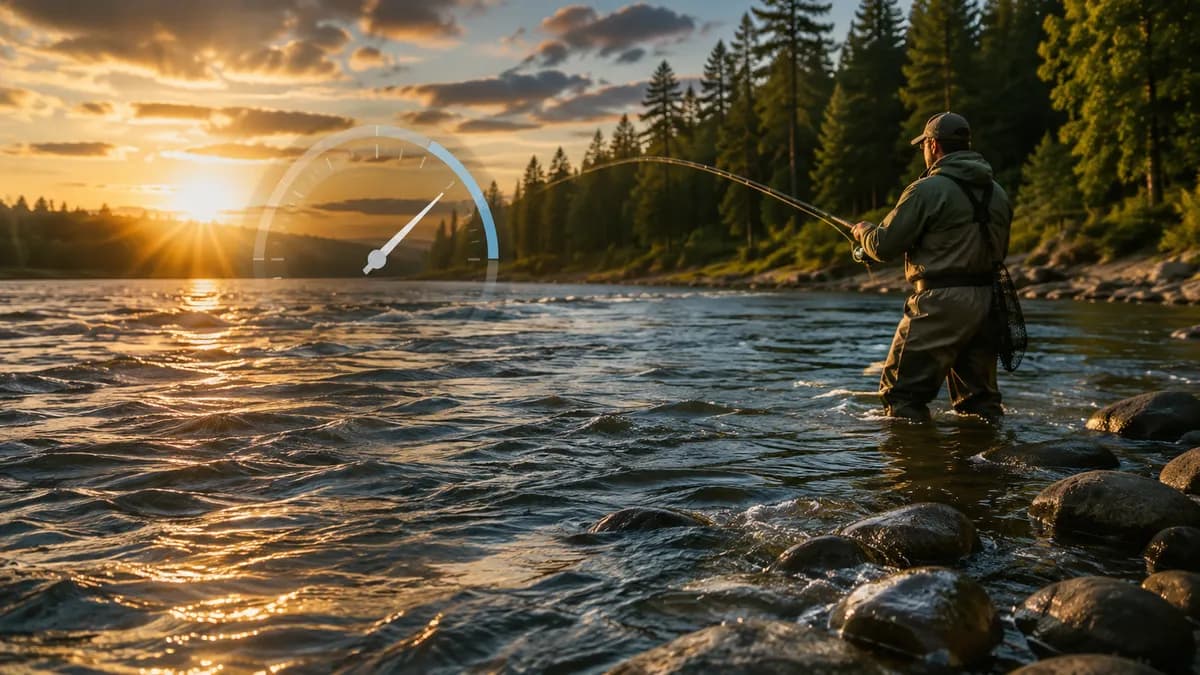
Anglers ask a simple question: is this a good time to go? The honest answer is never a single adjective. A window can be good for safety, good for access, good for the environmental conditions a fishery tends to use, and still be a poor day to catch fish — or the reverse. StrikeTracks is built to help with the environmental-planning part. It is not built to guarantee a cooler full of fish.
A window is a set of conditions, not a score you can take to the bank
On StrikeTracks, condition ratings and Should I Go-style trip guidance summarize the evidence a destination is allowed to use. That evidence might include flow, water temperature, weather, tides, or marine observations — depending on waterbody type and what actually qualifies. The same word, such as Fair, does not mean the same thing on a monitored trout river and an estimated lake. Evidence class comes first. See Monitoring-Backed vs. Estimated Fishing Conditions.
A “good” window in product language usually means the accepted model did not find blocking safety, conservation, or environmental problems in the inputs it has, and that enough of those inputs were present to say something. Missing data is part of the answer. A page that says a metric is unavailable is not hiding a secret Excellent underneath.
What a good window is not
- It is not a claim that fish are feeding, biting, or concentrated on a particular lure.
- It is not a wading, boating, or ice-safety certification. Fishing suitability and access safety are different questions.
- It is not a regulation check. Seasons, closures, and harvest rules come from the agency that manages the water.
- It is not stable for the whole calendar day if weather, generation, or tide will move. Conditions can change quickly.
Public trip language versus the condition rating
Should I Go uses explicit trip decisions: Go, Consider, Wait, Do Not Go, and Not Enough Data. Those labels are not synonyms for Excellent, Good, Fair, and Poor. A condition rating can look ordinary while Wait is still the trip answer — for example high relative flow on Swift River at West Ware, or a trout thermal gate on a cloudless afternoon. Unsafe conditions and Do Not Go are safety-adjacent. Not Enough Data is abstention, not Limited opportunity.
Confidence — High confidence, Medium confidence, Low confidence, and Window confidence: High, Medium, or Low — does not upgrade a Wait into a Go. When StrikeTracks Says Wait Even Though the Sky Looks Perfect is the labeled example. Research & Methodology states that a rating does not certify wading or boating safety.
How to judge a window as an angler
Separate four questions: (1) Is the evidence class one you are willing to trust for this trip? (2) Are the environmental inputs in a range that makes sense for the water and species you care about? (3) Can you access and fish it without taking a safety shortcut? (4) Do regulations and your own time budget still work? StrikeTracks helps most with (1) and (2). You own (3) and (4).
Timing language on a destination page — when it exists — is still not a bite forecast. It is a way of organizing environmental evidence across a planning horizon. A later window can look better on paper and still lose to a thunderstorm, a generation pulse, or a wind switch. Why Fishing Conditions Can Change So Quickly covers those jumps.
If you want a practical walkthrough of opening StrikeTracks and reading a destination without over-trusting the headline rating, use How to Use StrikeTracks to Plan a Fishing Trip. And read the disclaimer: recommendations are decision support, not certainty.
Sources and methodology
These are the primary sources this article actually relies on. Linked agencies do not endorse StrikeTracks conclusions.
- StrikeTracks Research & Methodology — Public trip decisions are Go, Consider, Wait, Do Not Go, and Not Enough Data. Secondary rating language includes Excellent opportunity, Good opportunity, Fair opportunity, Limited opportunity, Unsafe conditions, and Conditions unclear. Confidence labels remain qualitative and do not override safety.
Related Fishing Insights
- Monitoring-Backed vs. Estimated Fishing Conditions: What’s the Difference?
StrikeTracks uses two different evidence classes for fishing conditions. Here is what each one means, why they are not interchangeable, and how to read them honestly.
- When StrikeTracks Says Wait Even Though the Sky Looks Perfect
Clear weather is not a fishing-condition all-clear. A labeled catalog example on Swift River at West Ware shows why trip guidance can still say Wait or Do Not Go.
- How to Use StrikeTracks to Plan a Fishing Trip
A practical walkthrough of Explore, destination pages, evidence classes, and trip guidance — without treating StrikeTracks as a guarantee of success or safe access.