
Trip planning
When StrikeTracks Says Wait Even Though the Sky Looks Perfect
Clear weather is not a fishing-condition all-clear. A labeled catalog example on Swift River at West Ware shows why trip guidance can still say Wait or Do Not Go.
StrikeTracks Editorial Team2 min read
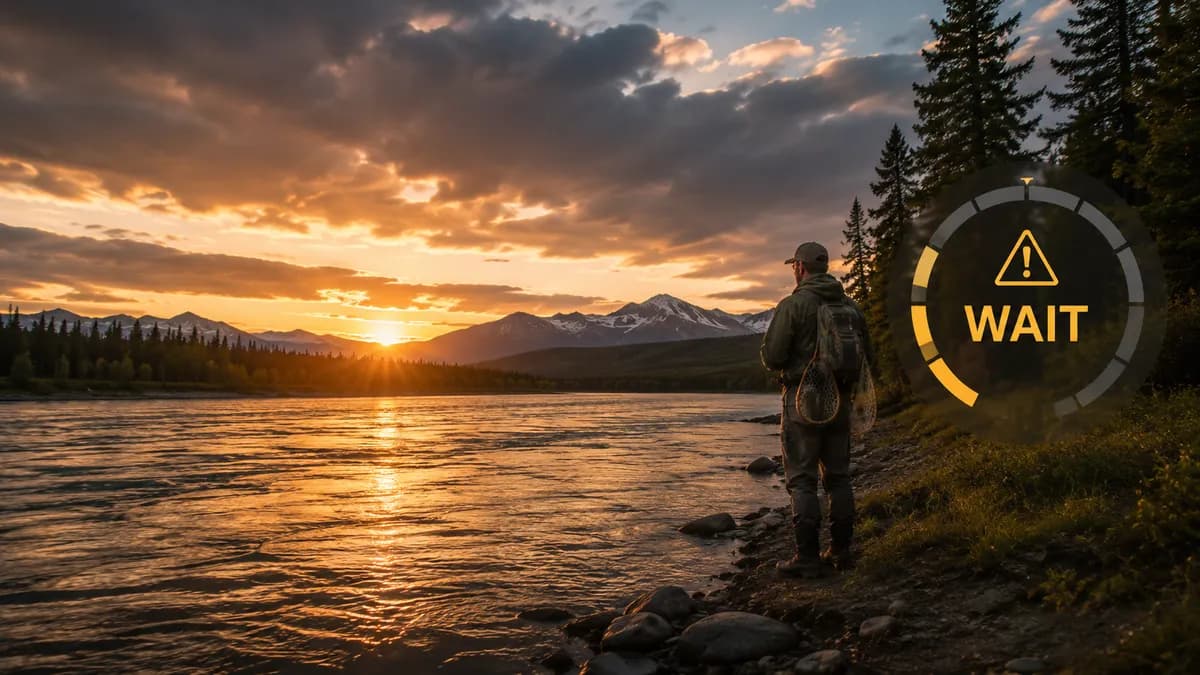
A blue sky is a weather observation. StrikeTracks trip guidance is not a weather app with a fish icon. Should I Go uses destination evidence: flow, temperature where it exists, marine hazards where they exist, and explicit safety or conservation gates. The sky can look perfect while the river is out of its catalog band, a trout water is thermally stressed, or a coastal warning is in force.
A labeled example, not this morning’s report
The following is a catalog-threshold illustration on Swift River at West Ware. It is not a claim that USGS 01175500 is at a particular value today, and it is not a field report from the bank.
Swift River at West Ware is a small Quabbin-release trout tailwater. The catalog Good flow band is 30–80 cfs; Fair extends to 120 cfs. If discharge at 01175500 sat well above that Fair ceiling — hundreds of cfs on a channel scaled for tens — trip guidance can still resolve to Wait even if the parking lot is dry and the sky is cloudless. The fishing-environment signal is the river. High relative flow on a tailwater is a reason to postpone, not a reason to trust the weather screenshot.
A second accepted gate: trout thermal stress
The same destination is a trout water. When qualifying water temperature is in a stress range, StrikeTracks can present Do Not Go as a conservation-adjacent gate even if the afternoon looks like a postcard. That rule is about the fish and the evidence, not about whether you would enjoy standing in the sun. How Water Temperature Affects Trout Fishing explains why air temperature must not invent that reading.
How to read the public labels
The customer-facing trip decisions are Go, Consider, Wait, Do Not Go, and Not Enough Data. Wait is not a personal insult. Do Not Go is not the same as Poor fishing. Not Enough Data is abstention. None of those labels certify that wading is safe when the decision is Go. The compact river notice remains: preliminary guidance only; assess weather, access, depth, current speed, and your own ability before entering the river.
If you want the broader planning vocabulary, What Makes a Fishing Window “Good”? separates condition rating from trip recommendation. If the conflict is “it looks fishy but I should not step in,” use Wading Conditions vs. Fishing Conditions.
Sources and methodology
These are the primary sources this article actually relies on. Linked agencies do not endorse StrikeTracks conclusions.
- USGS 01175500 — Swift River at West Ware, MA — The monitoring location assigned to StrikeTracks destination Swift River at West Ware. Use the station page for current and historical stage and discharge; this article does not invent a live reading.
- MassWildlife — Massachusetts freshwater fishing regulations, stocking reports, and trout-water management are authoritative for Swift River at West Ware and Charles River at Waltham. Confirm current rules before you go.
- StrikeTracks Research & Methodology — Public trip labels on StrikeTracks include Go, Consider, Wait, Do Not Go, and Not Enough Data. This article uses catalog flow bands and accepted thermal/safety separation as a labeled example. It is not a live report of today’s weather or discharge.
Related Fishing Insights
- What Makes a Fishing Window “Good”?
A good window is a planning judgment under uncertainty — not a promise that fish will eat. StrikeTracks ratings and Should I Go are decision support built from destination-specific evidence.
- How Water Temperature Affects Trout Fishing
Trout are coldwater fish, but species, life stage, and local water all matter. Learn what temperature changes in a stream, what it does not prove, and how StrikeTracks presents thermal context.
- Wading Conditions vs. Fishing Conditions
A river can fish well and still be a poor idea to wade. StrikeTracks keeps fishing suitability and hydrologic or wading safety as separate questions — and so should you.