
Conditions
Monitoring-Backed vs. Estimated Fishing Conditions: What’s the Difference?
StrikeTracks uses two different evidence classes for fishing conditions. Here is what each one means, why they are not interchangeable, and how to read them honestly.
StrikeTracks Editorial TeamUpdated 4 min read
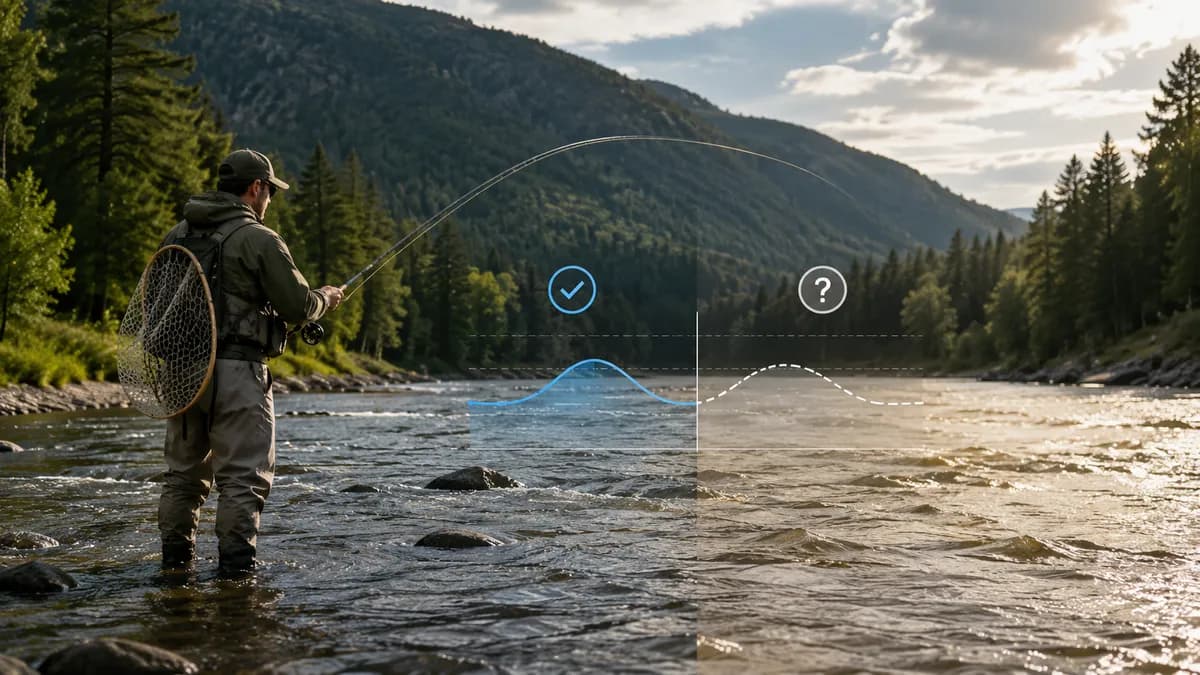
When you open a StrikeTracks destination, the first useful question is not “is this a good day?” It is “what kind of evidence is this page using?” StrikeTracks does not treat every waterbody as if it had the same sensors, the same refresh, or the same confidence. Two labels appear throughout the product for that reason: Monitoring-backed Conditions and Estimated Conditions.
Monitoring-backed Conditions
Monitoring-backed Conditions are based on qualifying current monitoring or data sources where those sources are supported for that destination. On a river, that often means a related streamgage and the observations StrikeTracks is allowed to use from it. On a lake or coastal destination, it means the accepted observations for that waterbody type — level, temperature, tides, marine weather, or other configured sources — when they actually qualify.
The important word is qualifying. A nearby instrument is not automatically the same thing as a destination’s own monitoring relationship. StrikeTracks is built to keep that distinction visible rather than silently substituting one site for another. If a destination does not have the accepted sources, it does not become Monitoring-backed by implication.
Estimated Conditions
Estimated Conditions are a clearly labeled, lower-confidence class. StrikeTracks uses them when qualifying direct monitoring is not available and an accepted estimated path exists for that destination. Estimated is not offered everywhere. It is not a hidden upgrade, and it is not a claim that StrikeTracks invented a sensor.
Estimated is also not equal in confidence to Monitoring-backed Conditions. The two classes can share a similar layout on the page — ratings, trip guidance, fishery notes — but they do not share the same evidence contract. If you treat them as interchangeable, you will over-read the estimated page.
What Estimated does not mean
- It does not mean the fishing will be the same as a monitored nearby water.
- It does not mean StrikeTracks has a private gauge, buoy, or camera that the public page forgot to mention.
- It does not make a rating more certain just because the number looks precise.
- It does not authorize coastal Estimated Conditions. Coastal destinations follow a separate rating and recommendation architecture; do not assume an inland estimated class exists on the coast.
How to use the distinction when you plan
Start by reading the evidence class before you read the rating. A Fair monitoring-backed river with a live discharge reading is a different planning object than a Fair estimated lake. The word Fair is not a universal score. It is a presentation of whatever evidence that destination is allowed to use.
Then read what is missing. StrikeTracks will not invent water temperature, flow, or tides to fill a hole. Unavailable observations are part of the answer. A page that withholds a metric is often more honest than a page that guesses one.
A river, a monitored lake, an Estimated lake, and Unavailable
Swift River at West Ware is Monitoring-backed: USGS 01175500 is assigned to that Quabbin-release reach. You can argue with the fishing interpretation of 40 cfs. You should not pretend the page is weather-only.
Allegheny Reservoir near Warren is a different monitoring shape. USGS 03012520 reports reservoir elevation, not live lake-surface temperature, and not the Kinzua outlet river. Elevation-only is still not a license to invent thermal ratings.
Burke Lake in Fairfax County, Virginia, has no same-lake USGS water-temperature station. Where accepted MODEL-2 ordinary inland Estimated coverage applies, the page must stay labeled Estimated — lower confidence, not offered as monitoring. Alum Creek Lake is the merged contrast REVIEW asked for: a real lake with complete static Fishery and Catalog-visible Unavailable conditions, because no same-lake live USGS 00010 exists. Africa 03228805 is not this lake. Unavailable is not Estimated, and it is not Poor.
Three honest classes, not a ladder you can climb by wishing harder: Monitoring-backed where qualifying sources exist; Estimated only on an accepted estimated path; Unavailable when the product must abstain. Why StrikeTracks Shows Unavailable Instead of Inventing a Rating continues the Unavailable cases. Research & Methodology is the publisher contract.
Decision support, not a guarantee
Condition ratings and recommendations are decision support. They are not guarantees of fishing success, safe access, or legal harvest. They do not replace looking at the water, checking weather and regulations, or knowing your own limits. The disclaimer exists because environmental products are easy to over-trust.
If you want the product-level explanation of how observations, fishery context, and trip guidance fit together, read the product page. If you want to see a destination yourself, start on the homepage Explore map and open a river, lake, or coastal page. The evidence class should still be the first thing you notice.
Sources and methodology
These are the primary sources this article actually relies on. Linked agencies do not endorse StrikeTracks conclusions.
- USGS 01175500 — Swift River at West Ware, MA — The monitoring location assigned to StrikeTracks destination Swift River at West Ware. Use the station page for current and historical stage and discharge; this article does not invent a live reading.
- USGS 03012520 — Allegheny Reservoir near Warren, PA — StrikeTracks uses this location for reservoir elevation (parameter 62615, NAVD88). It is not the Kinzua Dam outlet river, and it is not a substitute lake-surface temperature station.
- U.S. Army Corps of Engineers — Alum Creek Lake — USACE recreation information for Alum Creek Lake. It does not create a same-lake USGS water-temperature station for StrikeTracks conditions.
- StrikeTracks Research & Methodology — Monitoring-backed, Estimated, and Unavailable class language matches current About, Product, and homepage methodology copy. Burke Lake is cited as an ordinary inland Estimated path; Alum Creek Lake as structural Unavailable. Coastal Estimated remains unauthorized.
Related Fishing Insights
- What Makes a Fishing Window “Good”?
A good window is a planning judgment under uncertainty — not a promise that fish will eat. StrikeTracks ratings and Should I Go are decision support built from destination-specific evidence.
- How to Use StrikeTracks to Plan a Fishing Trip
A practical walkthrough of Explore, destination pages, evidence classes, and trip guidance — without treating StrikeTracks as a guarantee of success or safe access.
- Why StrikeTracks Shows Unavailable Instead of Inventing a Rating
Unavailable means insufficient evidence, not Poor fishing. Real river and lake examples show why StrikeTracks abstains rather than remapping a nearby station or guessing.