
Rivers
How River Flow Affects Fishing Conditions
Flow changes how a river fishes, how it looks, and how safely you can enter it. This article explains discharge in angler terms and how StrikeTracks uses destination-specific flow context.
StrikeTracks Editorial Team3 min read
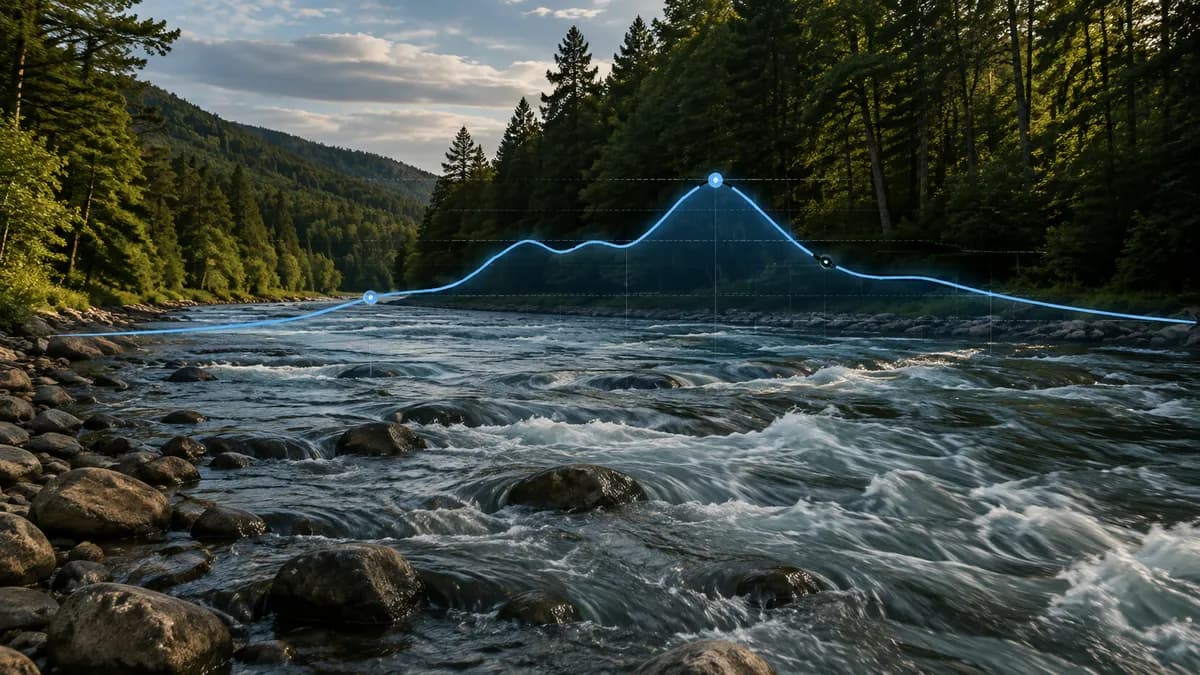
Anglers talk about a river being “up,” “dropped in,” or “skinny.” Those phrases are observations about flow: how much water is moving past a point, usually reported as discharge in cubic feet per second. Flow is one of the most useful river variables you can get from a public streamgage, and it is also one of the easiest to misuse.
What discharge actually measures
The U.S. Geological Survey computes streamflow from measured water level using a site-specific stage-discharge rating. Discharge is a volume moving past the gage, not a statement that the riffle in front of you is wadable, boat-friendly, or full of feeding fish. Two rivers can report the same cubic-feet-per-second value and feel nothing like each other, because channel shape, gradient, and width are local.
That is why StrikeTracks does not publish a universal “good CFS” number for trout, smallmouth, or any other fishery. A flow that is modest on a large mainstem can be pushy on a small freestone. A flow that looks low on a tailwater can still be dangerous below a generation pulse. Destination-specific context matters more than a round number copied from somewhere else.
How flow changes the fishing environment
Rising or high flow often increases depth and current speed, moves sediment, and can stain or muddy the water. Fish may shift to edges, slower seams, or cover. Presentations that worked in clear, moderate water can stop working simply because the fish cannot see them, or because the current will not let you fish them well.
Falling or low flow can concentrate fish, clear the water, and make approach more important. It can also raise water temperature, reduce dissolved oxygen in some settings, and leave less room between you and the fish. Low is not automatically “easy,” and high is not automatically “off.” Both are environmental states.
Recent change versus a single snapshot
A single discharge reading is a snapshot. Anglers often care as much about the recent hydrograph: whether the river is rising after rain, dropping after a generation cycle, or holding steady. StrikeTracks river pages may show current readings and, where configured, historical or advisory flow context. That context is still not a promise about tomorrow’s fishing.
Flow is not a wading or boating rating
StrikeTracks treats fishing suitability and hydrologic or wading suitability as separate questions. A river can have favorable fishing conditions and still be a poor idea to wade. It can also be physically enterable and still be a poor fishing window because of temperature, clarity, or other factors. See Wading Conditions vs. Fishing Conditions for that split.
How StrikeTracks uses flow
Where a river has a qualifying monitoring relationship, StrikeTracks can present discharge and related observations as Monitoring-backed Conditions. Flow bands, fair-range language, and any historical wading reference are destination-configured. They are not copied from another state or another river of the same name.
Where qualifying direct monitoring is not available, some rivers may use Estimated Conditions instead — a lower-confidence class, labeled as such, and not equivalent to a live gage. Estimated flow language still does not invent a nearby gage as if it were on-site. Read Monitoring-Backed vs. Estimated Fishing Conditions before you treat an estimated river like a telemetered one.
None of this replaces looking at the actual water, weather, and access. Ratings and Should I Go guidance are decision support. They do not guarantee catch rates, and they do not certify that a crossing, rapid, or dam release is safe. If a river page shows flow, use it as one input — then verify on site.
Related Fishing Insights
- How to Read a USGS Stream Gauge for Fishing
USGS streamgages report water level and often compute discharge. Learn what gage height, flow, and temperature mean for trip planning — and what they never tell you by themselves.
- Wading Conditions vs. Fishing Conditions
A river can fish well and still be a poor idea to wade. StrikeTracks keeps fishing suitability and hydrologic or wading safety as separate questions — and so should you.
- How Water Temperature Affects Trout Fishing
Trout are coldwater fish, but species, life stage, and local water all matter. Learn what temperature changes in a stream, what it does not prove, and how StrikeTracks presents thermal context.