
Coastal
Tide, Current, and Waves: Three Different Coastal Fishing Signals
Tide is water level. Current is water moving sideways. Waves are mostly wind acting on the surface. Mixing the three into one “the ocean is up” sentence hides the information that actually changes a trip.
StrikeTracks Editorial TeamUpdated 2 min read
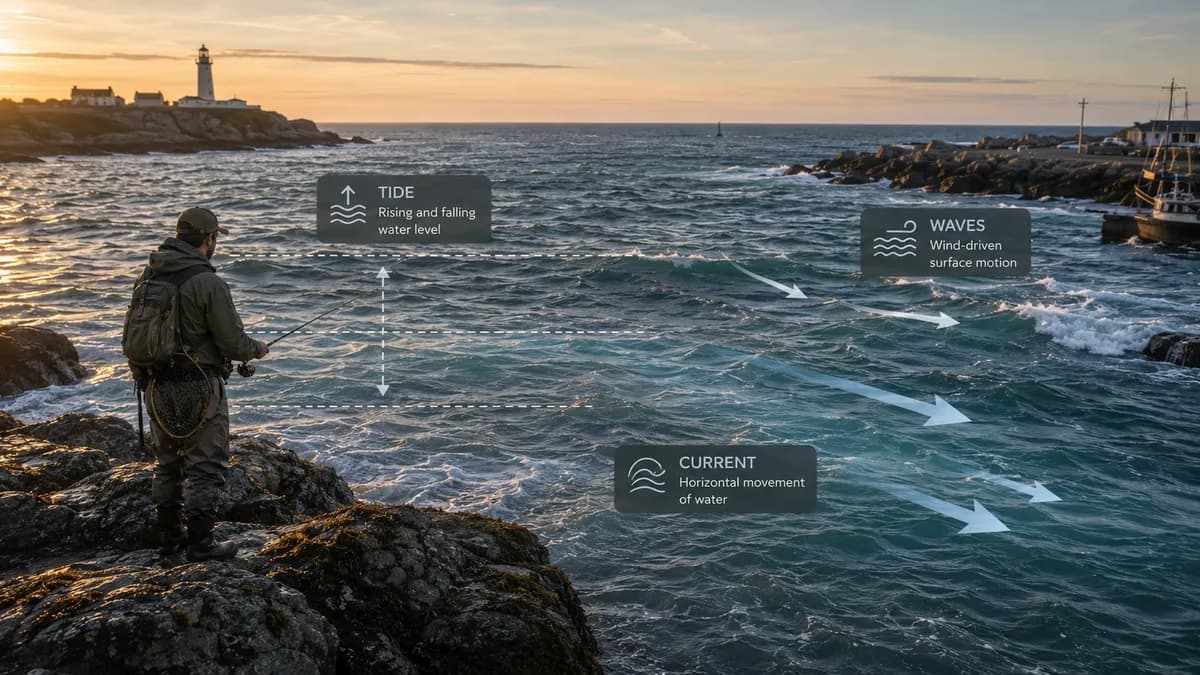
Coastal anglers often collapse three different measurements into one vibe: “it’s rough,” “the tide is running,” “the water is high.” NOAA’s public explainers separate them on purpose. Tides go up and down. Currents move left and right. Waves are a surface phenomenon driven mainly by wind, duration, and fetch. If you plan with only one of those words, you will misread the day.
Tide: vertical water level
NOAA describes tides as the regular rise and fall of the sea surface caused mainly by the Moon and Sun. Tide tables and NOAA CO-OPS predictions are about height at a station — high, low, and the range between them. That height changes whether a flat is covered, whether a bar is a hazard, and whether you can reach a trough. It does not, by itself, tell you how fast water is sliding past a jetty.
Current: horizontal motion
NOAA’s short fact sheet is the mnemonic: tides go up and down; currents move left and right. Tidal currents are the horizontal motion associated with the tide, and they are the current type that can be predicted in a regular pattern. Wind, weather, and river outflow also create nontidal current. NOAA current predictions are based on tidal current and do not include those other influences. Slack is a current idea (little horizontal motion), not a synonym for high tide.
Waves: wind on water
Wave height depends on wind speed, how long the wind blows, and fetch. NOAA’s currents tutorial is explicit that all three have to combine before large wind waves form. Swell can also arrive from a distant storm when the local breeze is light. Waves change boat safety, casting, and whether a bar is breaking. They are not a tide height and they are not a flood-current speed.
Why anglers mix them up — and how to stop
- Wind against a strong ebb can make a steep, short sea while the tide table still looks ordinary. That is waves plus current, not “a big tide.”
- A high tide with little current (near slack) can look calm and still cover a road or marsh you needed dry.
- A moderate tide range with a hard current in a narrow inlet is a boat-control problem even if wave height is small.
- Great Lakes water-level change is mostly not astronomical tide. Do not copy an ocean tide story onto a lake shore.
On StrikeTracks
Coastal destination pages may include tides, marine wind, or related observations where those sources are configured. They are still separate signals. StrikeTracks does not collapse them into a single invented “ocean score,” and coastal Estimated Conditions are not an implied product class. For tide planning, read How Tides Affect Coastal Fishing. For wind and NWS marine headlines, read Wind and Coastal Fishing. A favorable coastal window remains decision support — What Makes a Fishing Window “Good”? — not a forecast that fish will eat or that a bar is safe to cross. For a real destination’s station relationships, read Tide, Current, and Wind at a Real Coastal Destination.
Sources and methodology
These are the primary sources this article actually relies on. Linked agencies do not endorse StrikeTracks conclusions.
- NOAA: tides and currents — NOAA separates tide (vertical water level) from current (horizontal water motion).
- NOAA CO-OPS current predictions user guide — Current predictions omit wind, weather, and river flow at the surface. They are not the same product as a tide table.
- StrikeTracks Research & Methodology — This article stays a three-signal primer. The destination case study is Tide, Current, and Wind at a Real Coastal Destination (Boston Harbor and Islands).
Related Fishing Insights
- Tide, Current, and Wind at a Real Coastal Destination
Boston Harbor and Islands shows how StrikeTracks keeps tide level, tidal current, wind, and nearby waves on separate hooks — and why none of them guarantee a fish.
- How Tides Affect Coastal Fishing
Tides change water height; tidal currents change how water moves. NOAA is the U.S. authority for predictions. Here is what that means for anglers and how StrikeTracks presents coastal tides.
- Wind and Coastal Fishing: What Anglers Should Watch
Wind changes waves, boat control, and how water moves near shore. National Weather Service marine products are the place to start — and they are not a fishing-success forecast.